
Patch authoring
A Patch provider is an ordinary DSH plugin that declares one or more CommonJS modules. Harmony discovers those modules from the selected Loader profile before target plugins execute.
Provider declaration
Add Harmony metadata to the provider's package.json:
{
  "name": "my-dsh-plugin",
  "dsh": {
    "plugin": {
      "compatibility": {
        "requires": { "base-plugin": "^2.0.0" },
        "conflicts": { "legacy-patches": "*" },
        "integrates": { "optional-renderer": "^1.0.0" }
      }
    },
    "harmony": {
      "patches": ["./patches/answer.patch.cjs"],
      "after": ["base-patches"],
      "before": ["ui-patches"]
    }
  }
}
Patch files must be CommonJS modules. A module may export one Patch declaration or an array of declarations. Harmony collects them synchronously during live Loader updates.
If the provider itself cannot run without Harmony, use the existing DSH dependency mechanism:
export const inject = ['harmony']Or add the service to its Loader row:
- id: my-plugin
  inject: [harmony]
Source Patch
Source Patches select TypeScript AST nodes and edit the current source through MagicString:
/** @type {import('dsh-harmony').HarmonyPatch} */
module.exports = {
  id: 'answer-value',
  description: 'Changes answer() to return 42.',
  target: {
    package: 'some-dsh-plugin',
    version: '^1.2.0',
    file: 'lib/index.js',
  },
  select: 'FunctionDeclaration[name.name="answer"] NumericLiteral',
  expect: 1,
  after: ['base-patches'],
  apply({ node, sourceFile, edit }) {
    edit.overwrite(node.getStart(sourceFile), node.getEnd(), '42')
  },
}
select uses TSQuery. The callback receives:
| Field | Value |
|---|---|
patch | Stable key and provider owner |
source | Source produced by all earlier Patches |
sourceFile | Parsed TypeScript AST |
node | Current selector match |
edit | MagicString editor for the current source |
ts | TypeScript namespace |
Positions passed to edit refer to the source received by this Patch. file is one exact package-relative target. version is a semver range, and expect requires an exact match count.
Each Source Patch parses the source left by earlier Patches before running its selector. Harmony does not run every selector against the original AST first, because later selectors would then see stale nodes and offsets.
Loader Patch
Use a Loader Patch when a target package publishes TypeScript instead of JavaScript that Node can execute from node_modules:
/** @type {import('dsh-harmony').HarmonyPatch} */
module.exports = {
  id: 'load-published-typescript',
  target: {
    package: 'typescript-only-plugin',
    version: '^1.0.0',
    file: 'index.ts',
  },
  loader: 'typescript',
}
Harmony uses the target file to check compatibility and report status. Once the Patch binds, Harmony transpiles .ts, .tsx, .mts, and .cts modules in that package before Node's loader runs. It does not change loading for other packages.
Declare Source Patches separately when the TypeScript also needs modification. Exact-file Source Patches run before the current module is transpiled, while the Loader Patch covers its package-local TypeScript imports.
Semantic Patch
Named function declarations and class methods can be decorated without writing AST edits:
module.exports = {
  id: 'answer-after',
  target: {
    package: 'some-dsh-plugin',
    version: '^1.2.0',
    file: 'lib/index.js',
    function: 'answer',
  },
  operation: 'after',
  handler({ result }) {
    return result + 1
  },
}| Operation | Behavior |
|---|---|
before | Runs before the target and may return a replacement argument array |
after | Runs after the target and may replace a synchronous or asynchronous result |
around | Receives invoke(args?) and controls whether and how the next layer runs |
replace | Replaces the target through invoke(args?); only one enabled replacement may own a function |
All before handlers run in Patch order. around and replace form an outer-to-inner chain in Patch order. All after handlers then run in Patch order. Source and semantic Patches share the same global Patch order.
Semantic targets currently require named parameters and do not support generators. Handlers run in Node.js, so browser targets such as lib/client.js must use source Patches.
Composite Patch
Use a composite when several ordinary Patches must share ordering, enablement, and success or failure:
module.exports = {
  id: 'feature-set',
  after: ['base-patches'],
  patches: [
    {
      id: 'host-part',
      target: { package: 'target-plugin', version: '^1.0.0', file: 'lib/index.js' },
      select: 'StringLiteral[text="old"]',
      expect: 1,
      apply({ node, sourceFile, edit }) {
        edit.overwrite(node.getStart(sourceFile), node.getEnd(), JSON.stringify('new'))
      },
    },
    {
      id: 'client-part',
      target: { package: 'target-plugin', version: '^1.0.0', file: 'lib/client.js' },
      select: 'StringLiteral[text="old"]',
      expect: 1,
      apply({ node, sourceFile, edit }) {
        edit.overwrite(node.getStart(sourceFile), node.getEnd(), JSON.stringify('new'))
      },
    },
  ],
}
The composite has one stable key, one place in patchOrder, and one switch. Its members keep declaration order. Harmony tries every member against its target before committing; if one cannot bind or apply, it applies none of them. Members still run in sequence and read earlier output rather than querying one original AST in advance.
Ordering constraints
before and after refer to provider package names. They are sorting constraints, not npm or Cordis dependencies.
- Provider-level rules in
package.jsonare the default for every owned Patch. - Defining
beforeorafteron one Patch replaces the provider-wide rules for that Patch; it does not append to them. - The resolved global
patchOrdermay interleave Patches from different providers. - With no user override, declaration order remains the stable tie-breaker.
The user's order wins. Automatic sorting looks for the fewest violated rules and keeps the current relative order when several results tie. Contradictory rules stay visible as warnings; Harmony does not invent a numeric priority to hide them.
Moving a provider puts its Patches back together. Editing patchOrder keeps the chosen cross-provider placement. In either case, each Source Patch reads the output of the previous one.
Plugin compatibility
Any DSH plugin may describe package relationships under dsh.plugin.compatibility, whether or not it provides Harmony Patches. requires reports a missing, inactive, or incompatible dependency; conflicts reports an incompatible active pair; and integrates reports an available optional integration. Keys are package names and values are semver ranges.
These declarations report facts but never install, enable, disable, or block plugins. Live reports use plugins active in Loader; offline reports treat installed profile packages as active because no Loader state exists. Disabling a Patch does not disable its owning plugin.
Minimal WebUI example
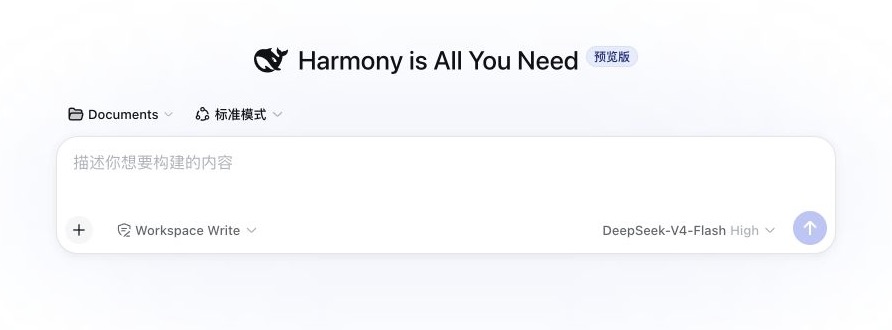
The following Patch replaces the new-session headline in the compiled conversation client:
const headline = 'Harmony is All You Need'

module.exports = {
  id: 'home-banner',
  description: 'Replaces the new-session headline.',
  target: {
    package: '@deepseek-ai/dsh-client-ui-conversation',
    version: '0.1.0-rc.8',
    file: 'lib/client.js',
  },
  select: 'StringLiteral[text="探索未至之境"]',
  expect: 1,
  apply({ node, sourceFile, edit }) {
    edit.overwrite(node.getStart(sourceFile), node.getEnd(), JSON.stringify(headline))
  },
}
Service and tooling APIs
Plugins can inject the harmony service:
export const inject = ['harmony']

export async function apply(ctx) {
  const current = ctx.harmony.profile()
  const snapshot = ctx.harmony.inspect({ package: 'some-dsh-plugin' })
  const result = await ctx.harmony.updateProfile({
    order: current.order,
    disabled: ['my-dsh-plugin/optional-patch'],
  })
}
The service exposes:
profile()for the committed profile snapshot;updateProfile(input)for a checked live update and its reload result;inspect(input?)for Patch status and transformed target snapshots;
For another local process, the package exports readHarmonyProfile, preflightHarmonyProfileUpdate, and updateHarmonyProfile. The last function uses the running Host transaction when the profile is live, or validates and atomically saves a stopped profile. Do not edit harmony.json directly while a profile is running. Preview and Draft lifecycle APIs come from WebUI Studio, not Harmony.